The 52-Point Gap: Between Your AI Strategy and Your Workforce
The 52-Point Trust Gap: Why Your AI Strategy Is a Leadership Problem Wearing a Technology Costume
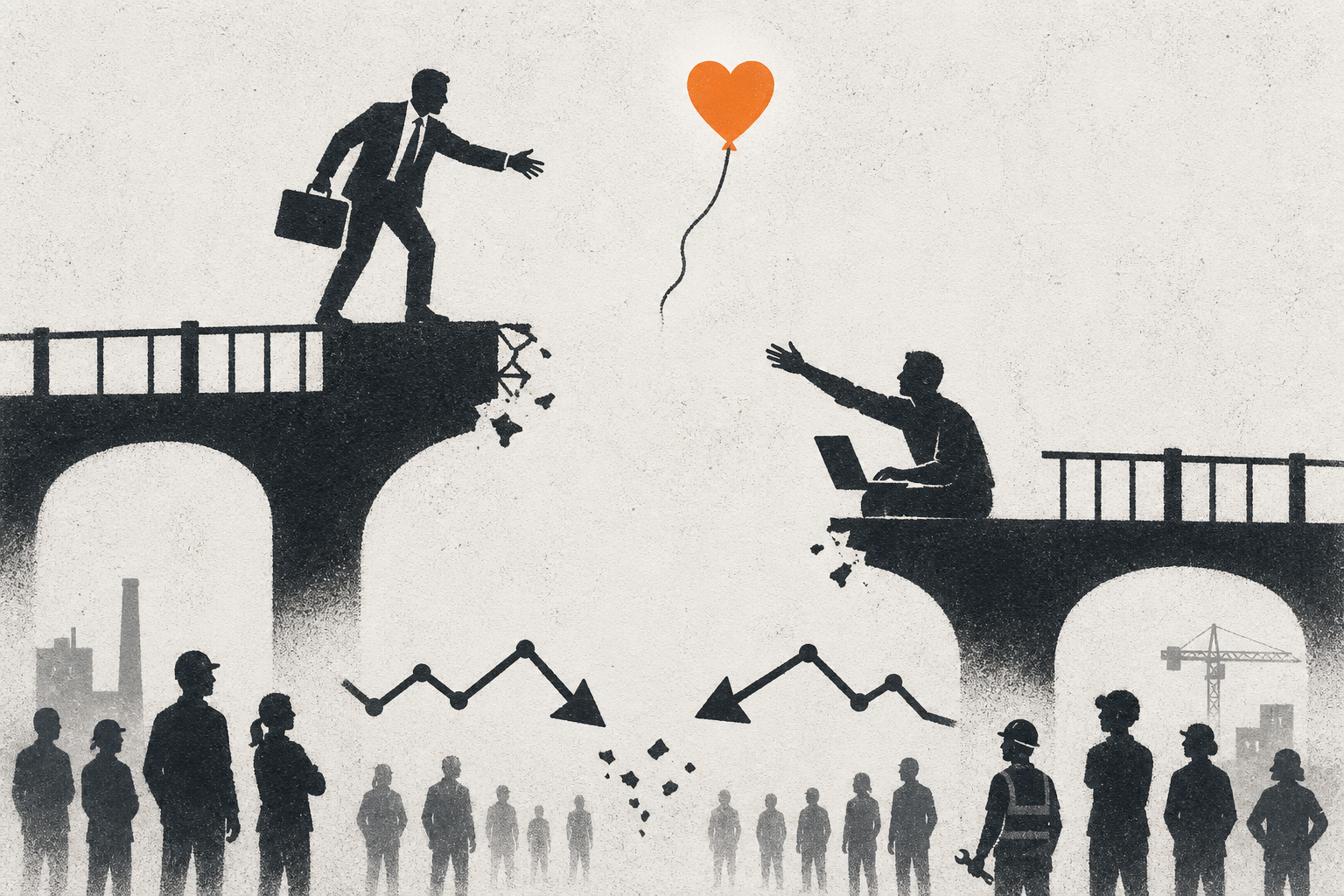
Executives know where they want to go. Practitioners know what the tools can actually do. The work that almost never gets done is building the bridge between them.
Executives know where they want to go. Practitioners know what the tools can actually do. The work that almost never gets done is building the bridge between them.
I’ve been watching this same disconnect play out across client engagements for fifteen years — long before AI was the topic. The pattern is structural, not situational. The layers of management that are removed from actually using a technology don’t really know what it can do. Their understanding is theoretical, surface-level, filtered through vendor decks and consulting summaries. They set strategic direction informed by an idealized image of the tool. Meanwhile, the practitioners who use it every day know its capabilities and constraints intimately, but their view of the company’s strategic direction is limited. Both groups are right about different things. Neither has the full picture. And the work that almost never gets done — across ERP rollouts, CRM deployments, data warehouse transformations — is building the bridge between strategic intent and practitioner reality.
AI is just the latest instance of this pattern. But it is not a typical instance. The capability gradient is steeper, the pace of change is faster, and the consequences of leaving the bridge unbuilt are significantly more expensive than any technology transition most organizations have navigated before. The organizations treating this as a deployment challenge — a matter of licenses, training sessions, and adoption dashboards — are misdiagnosing the problem. The trust gap isn’t a technology problem. It’s a leadership problem. And the data has now gotten specific enough to say so.
The 52-Point Gap: What the Numbers Actually Tell Us
Start with the numbers, because they’re striking enough to stop the usual executive conversation in its tracks.
A global survey of 3,750 executives and employees across 14 countries found that 61% of executives trust AI for complex, business-critical decisions. Only 9% of workers do. That 52-point trust chasm — between the people setting AI strategy and the people executing it — doesn’t narrow because the models improve. It narrows because leaders say and do credible things, consistently, over time.
PwC’s 2025 Global Workforce Hopes and Fears Survey adds a layer to this picture. Workers who feel most aligned with their leadership’s goals are 78% more motivated than those who feel least aligned. In the technology sector, 73% of employees say they understand their organization’s goals. Across the broader workforce, that number drops to 64%. Even understanding the goals — not agreeing with them, just comprehending them — varies by 9 points depending on whether you work at a company that invests in communication. And when it comes to actually believing in leadership’s ability to achieve those goals? The numbers fall further still, and fall hardest for non-managers.
The adoption data is consistent with this story. A survey of large-company data leaders found that 91% cite cultural challenges and change management as the primary barrier to AI implementation — only 9% point to the technology itself. The model is not the problem. The disconnect is the problem.
Two Altitudes, One Missing Bridge
Here is the structural diagnosis, stated plainly: your C-suite and your senior leadership have excellent visibility into where the business needs to go. Your practitioners — the people running prompts, testing workflows, hitting the edge cases — have excellent visibility into what the tools can actually do right now. Both of these things are valuable. They’re also insufficient on their own. And the bridge between them is usually absent.
This is the same gap that haunted ERP rollouts in the 2000s, CRM implementations in the 2010s, and data modernization projects throughout. Leadership defines the destination. Practitioners understand the terrain. What’s missing is the mechanism that translates between them — that lets strategic intent inform tool deployment, and lets practitioner reality inform strategic choices before those choices become expensive.
Steel-man the leadership side first: executives are supposed to think at altitude. Their job is to make directional calls without getting lost in implementation details. Expecting a CFO to spend hours in a prompt engineering session is the wrong model. They should be setting priorities, evaluating risk, allocating resources. That’s real. The problem is that with AI specifically, surface-level theoretical understanding is unusually wrong. The gap between what a frontier model can do and what an executive who has read a few vendor decks believes it can do is wider than in any prior technology wave. The assumptions that get embedded into AI strategy — about capability, about reliability, about what workflows can be automated and which cannot — are often grounded in a model that’s one or two capability generations out of date. Decisions made on those assumptions produce strategies that fail not at the deployment stage, but at the conception stage.
Steel-man the practitioner side: frontline workers using these tools every day have hard-won knowledge about where the models hallucinate, where they excel, which workflows actually compress with AI assistance and which expand. That knowledge is valuable. It’s also invisible to strategy if no structured channel exists for it to travel upward. The practitioner who discovers that a 10-step approval process can be collapsed into two steps with an AI workflow has no obvious way to get that insight into the quarterly planning conversation. So it doesn’t get there.
The missing bridge is not metaphorical. It’s a structural absence that produces the exact trust gap the surveys are measuring — because when leadership communicates about AI without grounded understanding of the tools, and when practitioners see strategies built on assumptions that don’t match reality, the credibility deficit compounds in both directions.
A Practitioner’s Note
How to spot a missing bridge in your own org.
Five symptoms — when you see two or more, the bridge isn’t there:
- 1.The AI tools officially sanctioned by the company are worse than the ones employees found on their own.
- 2.Your AI strategy deck cites capabilities your practitioners stopped using six months ago — or capabilities the model never actually had.
- 3.The adoption dashboard says rollout is on track, but informal conversations with frontline users tell a completely different story.
- 4.Practitioners have stopped raising tool-level concerns to leadership — not because the tools are working, but because raising them stopped being worth the effort.
- 5.No executive in the AI-strategy room has personally completed a real work task using the tool in the last week.
The bridge isn’t a piece of org-design abstraction. It’s a working two-way information flow. If the flow has stopped, the bridge isn’t there.
Why This Wave Is Different From the Last Three
The cynical read is that this is all just change management with a new label. Fine. The cynical read is also incomplete, because the thing being managed has changed.
Traditional change management — the Kotter frameworks, the stakeholder mapping, the roadshow communications — assumes something specific: the strategy is correct, and the problem is getting humans to adopt it. You identify resistors, you build coalitions, you communicate the burning platform. The model works when the strategic direction has been well-informed before rollout begins.
The problem with applying this model to AI is that the strategy formation is where the gap lives. It’s not that leadership has designed a good AI strategy and workers aren’t adopting it. It’s that strategy is often being designed by people whose theoretical model of AI capabilities is materially wrong, and that error doesn’t get corrected because no channel exists for practitioner reality to travel upward in time to inform the design.
This matters more with AI than with prior technology waves for a specific reason: the capability gradient changes faster. With ERP, you could spend a year learning the system before you needed to redesign your operating model around it, and the system you learned in year one was roughly the system you’d be operating in year three. With frontier AI, the capabilities available to your teams today are meaningfully different from the capabilities available six months ago, and the assumptions underlying last year’s AI strategy may already be wrong in ways that affect your decisions this quarter. The cost of the two-altitude problem — leadership operating on a stale theoretical model while practitioners have updated experience — compounds at a pace that prior technology waves didn’t require you to manage.
The data from the PwC workforce survey is specific on the human cost: employees who see no future for themselves in the AI transition, who experience psychological insecurity about their roles, who feel their managers’ narratives about AI don’t match reality — they disengage. Or as the Fortune reporting put it more bluntly, they sabotage. Not out of malice, usually. Out of a rational response to perceived threat combined with zero credible communication about what the future looks like. Management transparency, the survey finds, “can go a long way towards reducing fear and building trust.” That’s not a soft finding. It’s a measurement of the cost of the missing bridge, expressed in motivation and retention.
The IC View
The Org-Chart View
The Talent View
The Layer That’s Disappearing
There is a harder version of this argument, and it deserves to be made directly.
In January 2026, Philip Su — an OpenAI and Meta veteran who left OpenAI to found Superphonic — published a short essay with a blunt thesis: AI didn’t just change the individual contributor role, it killed it. Not because AI codes better than developers, Su argues, but because “maximizing your productivity necessitates focusing your time on all the things that are, at the end of the day, manager tasks.” Setting priorities across parallel agent workflows. Choosing architectures. Allocating tasks to whichever model handles them best. Resolving conflicts between AI outputs. Whether you wanted it or not, Su writes: “your job is now managing a fleet of AIs.”
At roughly the same time, what’s been called the “Great Flattening” in coverage through 2025 and 2026 has been removing the middle of org charts at Meta, Amazon, and Musk’s companies — deliberately raising IC-to-manager ratios and cutting the layers whose primary function was translating strategy into task assignments for humans. The operational logic is that if agents handle the tasks and senior leaders set the direction, the translation layer becomes structurally redundant.
Then, in April 2026, CNBC reported that several top-level executives from Salesforce, Snowflake, and Palantir had joined OpenAI in recent weeks. Denise Dresser, formerly CEO of Slack within Salesforce, joined as OpenAI’s CRO — described as “one of OpenAI’s splashiest software hires.” Jennifer Majlessi, previously at Salesforce, joined as head of go-to-market and posted on LinkedIn: “What makes this opportunity especially meaningful is my genuine belief in the product. I’ve seen how useful this technology can be in both work and life.” And critically, OpenAI also poached forward-deployed engineers from Palantir — professionals described by CNBC as “top-tier professionals skilled at helping clients implement instrumental changes to their businesses on-site.” This isn’t a story about executives chasing prestige. Forward-deployed engineers are the operationally-skilled implementation layer, the people who know what enterprise AI deployment actually requires at ground level.
Read these three signals together and a single underlying shift comes into focus. Su shows the IC role becoming managerial because the reports are now agents. The Great Flattening shows the org-chart middle being removed because its core function — human-to-human task translation — is being automated away. And the CNBC migrations show senior executives and elite implementation professionals making a revealed-preference bet that the functional unit of value is shifting: that strategic altitude and tool fluency need to live in the same person, and that they are relocating themselves to where that model is already operating before the rest of enterprise understands it.
The layer that doesn’t fit the new shape is precisely the layer that has historically been responsible for bridging strategy and practice — the middle management and senior IC layer whose function was translation. That layer is being compressed from both ends simultaneously. Which means the trust gap in the survey data is not only a productivity and morale problem. For a significant portion of the workforce, it’s also a survival signal. And the leaders who understand that early are the ones who can design transitions that preserve institutional knowledge instead of losing it.
What Leaders Should Actually Do This Quarter
The bridge is closing. Not because leadership has finally gotten serious about change management, and not because practitioners are coming around. It’s closing because the organizational economics are forcing it — the middle layer is being cut, the tools are changing fast enough that theoretical understanding decays in months, and the trust gap is now measurable in points and correlated with sabotage rates.
The question is whether you’re building the bridge deliberately or whether you’re waiting to be bridged over.
Two actions, specific enough to put in a calendar. First: executives should spend two hours a week using the AI tools their organization is deploying — not watching demos, not reviewing dashboards, using them on real work problems. There is no substitute for this. The credibility gap between leadership’s AI narrative and practitioner reality closes only when leadership has first-hand experience of where the models are genuinely useful and where they fail. The executives at frontier AI companies didn’t join to oversee an abstraction. They joined because direct experience with the capability gave them judgment that slides cannot convey.
Second: create a structured upward channel for practitioner reality to reach strategists — a monthly practitioner council, an AI friction log that surfaces to leadership, a direct feedback mechanism with teeth. Not a suggestion box. A mechanism with a named executive owner and a cadence for response. Workers who feel psychologically safe and aligned with leadership’s goals are 78% more motivated than those who don’t. That alignment doesn’t happen through all-hands announcements. It happens through visible evidence that the information flow is bidirectional.
Without both, the gap doesn’t close. The bridge has to be built from both ends.
Sources
-
Faisal Hoque, Thomas H. Davenport, Erik Nelson · April 2025
-
PwC · November 2025
-
Rapid Response (Masters of Scale, host: Bob Safian) · October 2025
-
Stanford HAI (Stanford Institute for Human-Centered AI) · April 2026
-
Philip Su · January 2026