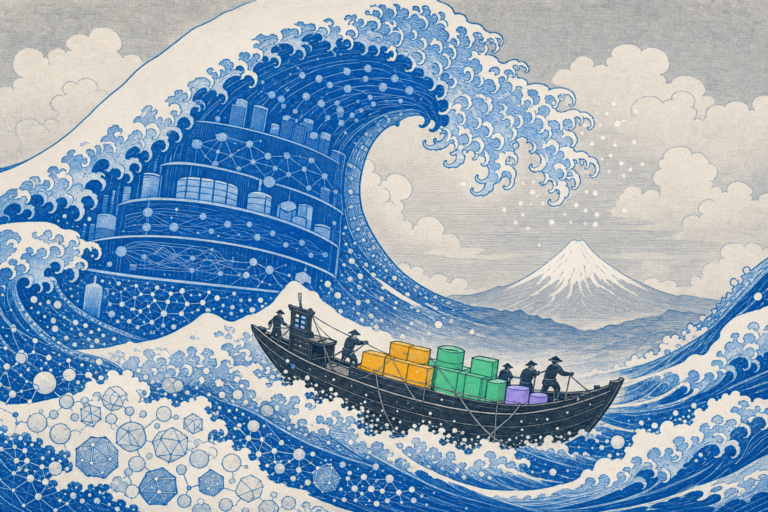
The Half-Life of an AI Strategy: Is Yours Already Expiring?

The Half-Life of an AI Strategy: Why Staying Current Is Now a Core Competitive Discipline, Not a Nice-to-Have
What happens to a company that builds its AI strategy on last year’s capability curve?
There is a particular kind of organizational trap that looks, from the inside, exactly like prudence. You move carefully. You let others fail first. You wait for the technology to mature before committing. In most eras, that posture earns respect — the discipline to resist hype cycles is a genuine executive virtue. But there is a category of technology where waiting is not caution. It is compounding disadvantage. Generative AI, right now, is that category.
The reason isn’t that the models are improving. Everyone knows the models are improving. The reason is the rate at which improvements are crossing consequential thresholds — not incremental gains but step-changes in what is actually possible. Tasks that reliably illustrated AI’s limitations twelve months ago have been resolved. Capabilities that would have defined standalone software products eighteen months ago are now baseline features of the frontier offerings from OpenAI, Anthropic, and Google. The best practices for building with AI, according to practitioners closest to the technology, are changing every two to three months.
That pace creates a specific and underappreciated problem: an AI strategy has a half-life. The assumptions baked into a strategy document from eighteen months ago — about what the models can’t do, about which vendors hold defensible positions, about which use cases are worth pursuing — may be wrong not because the strategy was poorly conceived, but because the ground shifted beneath it. And most organizations are still working from that map.
This article is about what that means in practice: why staying current on AI capabilities is no longer a research function or an innovation team luxury, but a core competitive discipline that belongs on the same priority tier as financial planning and talent strategy.
The Capability Curve Is Moving Faster Than Your Review Cycle
Start with an empirical claim that should trouble anyone running an annual strategy process. The “jagged frontier” — the useful idea that AI has surprising areas of strength alongside surprising blind spots — has been the dominant frame for calibrating AI expectations in boardrooms for the past two years. It gave executives a vocabulary for explaining why AI wasn’t ready for certain applications. It was a good frame. It is becoming less useful because the frontier is narrowing.
The edge cases that once anchored skeptical arguments — the reliable demonstrations of AI incompetence that made for compelling boardroom cautionary tales — are, one by one, getting resolved. What remains are increasingly technical, domain-specific, and debatable limitations. Not the clear failures that once justified deferral.
The agentic layer makes this concrete. For years, the working assumption was that autonomous AI agents were constrained by error accumulation: hallucinations compound over long task chains, making sustained independent work unreliable. That assumption is now outdated. Larger models are self-correcting at rates that make extended agentic work viable. In one instructive evaluation, domain experts with an average of fourteen years of experience were given tasks requiring four to eight hours to complete. AI systems produced comparable outputs — rated nearly fifty-fifty in blind expert review — in five to ten minutes. In software specifically, the AI outperformed the humans most of the time.
The agentic layer isn’t something to plan for in a future roadmap. It’s already embedded in the interfaces most knowledge workers use daily. Your review cycle is almost certainly not keeping pace with that kind of movement.
The Bitter Lesson Comes for Business
There is a concept from machine learning research — the “bitter lesson” — with a premise that is simple and uncomfortable: your beautiful, handcrafted solution to a specific problem will eventually be destroyed by a general-purpose model trained at scale.
The chess analogy is instructive. For decades, building a competitive chess engine meant hiring grandmasters and encoding every gambit and position. That was the craft. That approach powered the systems that defeated world champions. Then a model learned chess from scratch by playing itself — no human knowledge encoded, no expert consultation, just computation and reinforcement learning — and it obliterated everything that came before.
The business analogy is arriving in real time. When practitioners pushing the boundary on AI agents noted that an early system lacked a visible task list, the response from the developers was clarifying: the model is directly reinforcement-learning trained on what good outputs look like. It just does it. No explicit process. No handcrafted logic. The process disappears. The moat evaporates.
The implication for these organizations is pointed: if your product or service’s value is primarily in the output — a report, a customer interaction, a generated document, an analysis — a general-purpose model can increasingly be trained to match or exceed it. The specific moat you’ve built around your expertise in producing that output is exactly what the bitter lesson targets.
Where moats survive is where process is the point. Where the back-and-forth matters. Where human interaction, organizational judgment, and multi-stakeholder workflows are inseparable from the value delivered. The organizations that will weather this well are the ones that can honestly answer the question: is our value in the output, or in the process of producing it? Most haven’t asked it rigorously yet.
The Incumbent Paradox and the Ethics Committee Problem
When large language models first entered mainstream awareness, the conventional wisdom favored incumbents. They had distribution, customers, and existing data relationships. AI would arrive like electricity — a utility wired into existing products. Startups would struggle to compete.
That narrative has fractured.
The frontier labs didn’t just provide a commodity input and stop. They kept shipping. Capabilities that would have defined standalone products just eighteen months ago are now baseline features. Meanwhile, many large organizations are still being governed by AI ethics committees assembled in early 2023 — bodies that don’t fully understand current technology and are working through backlogs of hundreds of use cases. The models have moved on by several generations. The committee’s frame of reference has not.
The phase progression most enterprises are experiencing tells the story clearly. Phase Zero: AI ethics committee formed, rules established, real adoption stalls. Phase One: co-pilot deployed, “talk to your documents” solution built, works moderately well, not transformative. Phase Two: direct tool access, build-versus-buy decisions, vendor fatigue sets in. Phase Three: the locus shifts from IT to organizational design, and the question is no longer which tool to buy — it is how the organization itself stays current as the tools keep changing.
The organizations that have made it to phase three have something in common that isn’t obvious from the outside: they’ve stopped treating AI landscape awareness as an occasional input and started treating it as an ongoing organizational function. Not a person staying current. A repeating process.
One widely repeated statistic in boardrooms holds that 95% of AI projects fail. It has the feel of rigor. The underlying research is not a peer-reviewed study. Organizational inertia justified by a misquoted statistic is not caution. It’s comfortable decline wearing caution’s clothes.
The Switching Cost Reckoning Is Already Underway
There is one more assumption embedded in many organizational AI strategies that deserves scrutiny: that the enterprise software landscape will remain stable enough for long-cycle vendor commitments to make sense.
At the Fortune 50 level, a consistent message is emerging from CTOs: “We’re not signing another five-year contract.” Some organizations are already running experiments where AI agents interact with legacy systems through their human-facing interfaces — using the UI as a bridge — to extract and recombine data without a formal migration. It is slow. It is imperfect. It is happening right now.
The incentive is clear: hundreds of millions of dollars in potential savings, and accumulating frustration with lock-in that no longer delivers proportional value. Mid-market companies face the same structural tension at smaller scale, but the logic is identical. When a general-purpose model can be instructed to complete the output your specialized software produces, the switching cost calculation changes.
The organizations that navigate this well are the ones building genuine operational intelligence — not just deploying tools, but continuously evaluating which tools still earn their place. That requires an ongoing function, not a one-time audit.
Staying Current Is a Business Function, Not a Personal Habit
Here is where most AI strategy discussions arrive at the wrong prescription. The diagnosis — your strategy has a half-life, your review cycle is too slow, the capability curve keeps moving — is correct. But the prescription that typically follows is individual: senior leaders should stay current, read more, personally engage with the technology.
That’s necessary but not sufficient. Personal AI literacy matters. But treating landscape awareness as a leadership habit rather than an organizational function is how companies end up relying on whoever happens to be most engaged this quarter — and stalling when that person’s attention moves elsewhere.
The organizations that consistently stay ahead of the capability curve have solved this structurally. They have a process — not a person — responsible for scanning what’s changed, filtering what’s relevant to their specific business, running fast experiments on the most promising developments, and delivering a prepared brief on what to act on next. The cycle repeats. Each pass builds on the last.
The logic is straightforward: sense what’s changing in the AI landscape, run lightweight experiments on what looks relevant, incorporate the findings into the roadmap — and repeat on a cadence faster than your planning cycle. Monthly scanning catches what’s new. A quarterly deep brief ensures the strategic picture is current. Immediate escalation handles what can’t wait. The map gets updated on a schedule, not when someone finds time.
What this produces is durable. Organizations with this function make better sequencing decisions because they’re working from an accurate, current picture of what’s possible. They avoid sunk-cost traps on tooling that was state-of-the-art eighteen months ago. They find leverage points earlier than competitors who wait for the dust to settle — because they started updating the map before the dust cleared.
The Question Isn’t Whether to Commit — It’s Whether You Have the Function
The organizations that will define the next generation of competitive advantage won’t necessarily be the ones that moved first. They’ll be the ones that built the organizational reflexes to absorb new capabilities quickly, evaluate them rigorously, and refit processes around them without losing strategic coherence.
That’s a different capability than building a point solution for a specific use case. It requires treating AI as a living platform, not a one-off project. It requires a function dedicated to keeping the map current — not a memo, not an annual review, not a senior leader’s reading list, but a repeating cycle with clear inputs, clear outputs, and clear accountability.
The half-life of an AI strategy, right now, is probably shorter than your annual planning cycle. The companies that understand that — and build the organizational discipline to refresh the map on that cadence — are the ones compounding real operational intelligence while competitors are still working from last year’s assumptions.
The question is no longer whether to commit to AI. That decision was made. The question is whether you have the function in place to stay current as the ground keeps shifting. Most organizations don’t. The ones that build it stop being surprised by what their competitors already discovered — and start being the ones who discover it first.
Sources
-
Andrew Ng · July 2025
-
Harvard Business Review · April 2026
-
Bain & Company · December 2025
-
Peter Diamandis · April 2026
-
Ethan Mollick · March 2026